A Plum By Any Other Name

  • Stories
  • About
  • Recipes
  • Images

Early Riser Polenta, For Us Humans

April 03, 2013 by Emily Gelsomin in For Herbivores, With Whole Grain

Very scary things have been said about polenta.  It is pasty.  It needs to be fussed over or it is all lumps and bumps. It burns if you so much as glance at it wrong.     

But here is the secret.  It has to be stirred.  And this cannot be hurried.  That is it.

It knows what it needs.  And what it needs is an hour to be ready.  So do not rush it.  Making polenta is mediation by way of cornmeal. 

I felt this needed to be discussed for a few reasons. 

One.  Because I had an early dinner with my brother a few weeks ago and the man revealed he has yet to latch on to the right polenta recipe.  Since he owns my great grandmother’s hand crank cavatelli maker, and actually uses it, I can assure you his polenta void is not for lack of wont.

Two.  Because at said dinner at a trendy-new-restaurant-which shall-remain-nameless, we had a side of farro that was barely passable.  Sad and pale and bored.  Like a New Englander trudging through March. And this should simply not be the case for Italian grains that require so little to taste delicious.

Three.  Because I recently visited Misty Brook Farm and have fallen for their Early Riser cornmeal, which they also feed to their pigs and chickens.  And I hope this balances out some of the implied elitism when I say it is organic, meaning it is a non-GMO rarity and is from a local farm. 

Any food that is fed to both farm animals and humans can't be too highbrow.  In fact, I hope we can come to live in a world where people say, “If it’s good enough for the pigs, it’s good enough for me.” 

During my research, I also stumbled across this quote from an online garden supply store about using Early Riser: “Chickens will produce eggs with deep golden yolks, cows love it, and it makes a high quality cornmeal for us humans as well.”  Now, cows are not technically built to eat corn.  But that aside, it is ground so fine and delicate that it makes the creamiest polenta known to man.

But you still have to stir it. 

So do your dishes while it gently bubbles on the stove.  You see, the key is stirring, and patience.  This makes a high quality polenta for us humans, as well.

Early Riser Polenta

Ingredients:

  • 5 cups water
  •  ½ teaspoon kosher salt, plus additional, to taste
  • 1 cup cornmeal
  • 2 tablespoons (1 ounce) butter
  • ¼ cup grated Parmesan cheese
  • Pinch of crushed red pepper
  • Black pepper, to taste

Instructions:

In a 2-quart saucepan, bring the water to a simmer.  Add the salt and then slowly whisk in the cornmeal.  Continue to whisk until any lumps dissolve.

Reduce the heat to medium-low and cook the cornmeal for about an hour, stirring regularly to prevent any lumps from forming.  The cornmeal will bubble occasionally. If it starts to sputter and splatter, turn down the heat.

The polenta is done when it is creamy and has reduced roughly by half.  (It should not taste floury or raw, if it does, cook it longer.)  Stir in the butter, cheese, and crushed red pepper.  T

Taste and adjust for seasoning.  Serve hot.

Makes about 3 cups

Notes:

  1. I have made the recipe with standard yellow polenta (typically medium or coarse ground cornmeal), as well. (You can find Early Riser at Misty Brook Farm.)
  2. If your polenta is looking too dry, add in a drizzle of water.
April 03, 2013 /Emily Gelsomin
polenta, whole grain
For Herbivores, With Whole Grain

Dark Winter Rye Boule

March 15, 2013 by Emily Gelsomin in With Whole Grain

The past few days have felt like a week of Mondays, strung together.  I interviewed a worker on Misty Brook Farm on Sunday.  And the co-owner of The Wine Bottega on Tuesday.  Did a lot of writing.  Worked all week, like a regular human.  And cursed at the wind today because it was so cold. 

What I really want right now is for someone to do my dirty dishes and pour me a glass of wine. 
But that someone will have to be me tonight.  So I hope you will forgive me if I am curt.  

This pretty much sums things up: winter rye boule.  Because it is (still) winter.  But also because it is the hardy variety I bought from Misty Brook Farm.  Which they grow and mill themselves.

Some winter rye, a little molasses, hint of cocoa, and a bit of caraway seeds was all it took to transform everyday bread into a dense and lovely loaf to chase out the end of winter.  While many dark ryes rely on caramel coloring to get their hue, this version uses the cocoa and molasses to impart a chocolate tint that deepens as the bread bakes.

The recipe borrows from Jim Lahey’s no-knead method of Sullivan Street Bakery in New York City.  So you can mix it up the ingredients in a bowl on your counter.  And then clean the dishes.  Or do the laundry.  

Or, better yet, open a bottle of red.

Dark Winter Rye Boule

Ingredients:

  • 2¼ cups bread flour, plus extra for dusting
  • ¾ cup rye flour
  • ½ tsp active dry yeast
  • 1½ tsp kosher salt
  • 1½ cups cold tap water
  • 1 tbsp blackstrap molasses
  • 1 tbsp plus 2 tsp unsweetened cocoa powder
  • cornmeal, for the bottom of the bread
  • 2½ tsp whole caraway seeds, divided

Instructions:

the day before

In a large bowl, combine the flours, yeast, and salt.  (Start this process 15 to 22 hours before you plan to eat the bread.)  Fill a measuring cup (or small bowl) with the water and vigorously whisk the molasses and cocoa into the water until it turns dark brown.  

Add the liquid to the flour mixture and combine the ingredients using a rubber spatula until a sticky dough forms (it will be wetter than standard bread dough), add more water, if needed.

Cover with plastic wrap and let rise 12 to 18 hours in a warm, undisturbed spot.  During this time, the dough will double in size and become puffy.

the day of

To start the second rising of the dough, scatter a handful of cornmeal in the middle of a clean kitchen towel. 

Add 2 teaspoons of caraway seeds to the dough and, with floured hands, take it out of the bowl and gently stretch the dough by tucking the sides of the bread together to meet at the bottom (if it is too sticky to handle, add a little bread flour); continue this process until the seeds are fully incorporated and the top is smooth. 

Shape into a round ball.

Place the dough on the cornmeal, sprinkle the top with the remaining ½ teaspoon of caraway, and cover with the sides of the kitchen towel. Let the dough rest for 1 to 2 hours (until it rises slightly).  

30 minutes before you plan to bake the bread, set the oven at 475 degrees and place a 4 or 5 quart Dutch oven or roasting pan with a tight-fitting lid on the middle rack of your oven.  (Be sure your pan can withstand the high heat and avoid pans with plastic parts.)  Preheating the pan helps the dough expand rapidly to produce a chewy interior and a crispy crust.

After 30 minutes, take the pan from the oven and remove the lid.  Gently place the dough into the pan, cover it with the hot lid, and bake for 30 minutes.  

Uncover the bread and bake for another 15 to 30 minutes, until the top is golden brown and the bottom sounds hollow when tapped.  (If you are unsure, the internal temperature of the bread should be 190 degrees.)

Let cool fully on a wire rack before slicing (1 to 2 hours).

Makes 1 loaf

Notes:

  1. I baked this bread in a BreadPot, which I got for Christmas.  Make sure whatever you use can be heated up to 475.
  2. You may be able to find Misty Brook at the Somerville Winter Farmers' Market on Saturdays.
     
March 15, 2013 /Emily Gelsomin
bread, rye, whole grain
With Whole Grain

Breton Fleur de Sel Buckwheat Cake, Sun in the Sky

March 01, 2012 by Emily Gelsomin in With Whole Grain, Dessert


I have accepted this time of year tends to be a bit bland for my taste.  The grayness that lurks in the crevice of February and March usually forces me into hibernation.  During this time I keep to myself, and try to keep out of trouble.  This year I failed, miserably. 

The two-day affair I had with an unforgiving frozen yogurt recipe is one I would rather forget.  An encounter with a slab of pork belly shot me straight out of a dead sleep, our earlier romance lingered violently on the cold bathroom floor for the next few hours. In a last-ditch effort, I looked for solace in a lackluster bouillabaisse, wasting saffron and drinking too much wine in the process.

Of course none of this helped.  I just felt puffy.  I stopped interacting with others. Bright lights became irritating.  I growled at people showing signs of affection.  I began to wonder if maybe I had Asperger’s. 

But then I made this cake. It was a quiet Sunday afternoon.  As the sugar and butter fluffed up, I started to breath again.  Once the smell of cinnamon and dark rum crept through my apartment, I stopped grinding my teeth. 

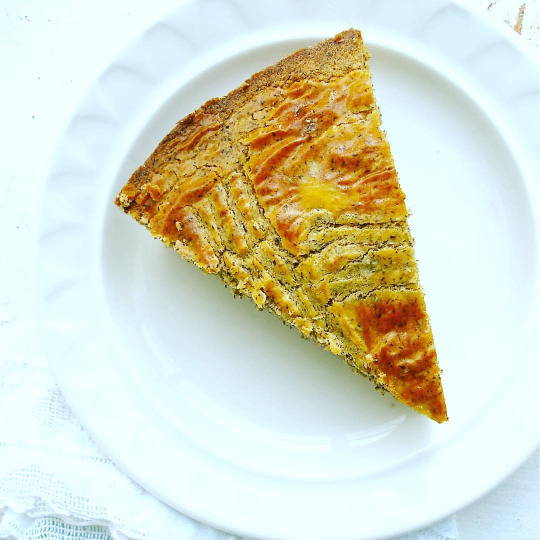
When I took the cake from the oven, its glossy, yellow crosshatched pattern smiled at me with a cakey gap-toothed grin.  For the first time in quite a long while, I did not feel compelled to scoff. 

I heard Nina Simone’s “Feeling Good” start up in my head.  Fish in the sea, you know how I feel.  Blossom on the tree, you know how I feel.  Everyday cake lovers, you know how I feel.

This is a rich cake that uses nutty buckwheat to its advantage, playing off the butter and rum.  The fleur de sel melds these flavors, supports them, and serves as a salty backbone for the cake. 

It is a simple cake.  A very pretty cake.  A special cake that looks and tastes far better than its ingredients would lead you to believe. 

And so I am leaving my hole.  Winter recluses, you know how I feel.  The end bits of February never seem very pleasant.  Not that this cake is a cure-all, but it is certainly a welcoming recipe. A worthy end of winter companion.  Amazing what a little butter and buckwheat can do.

It’s a new dawn.  A new day.  And a new cake.  And I’m feeling good.

Breton Fleur de Sel Buckwheat Cake

Adapted from Diary of a Locavore

Ingredients:

for the cake

  • 1 cup buckwheat flour
  • 1 cup all purpose flour
  • a scant ¾ tsp fleur de sel, plus a few extra grains to sprinkle on top of the cake
  • ¼ tsp cinnamon
  • ½ pound (2 sticks) unsalted butter, softened
  • 1 cup light muscovado sugar
  • 4 large egg yolks
  • 1 large egg
  • 1 tsp vanilla extract
  • 2 tbsp dark rum

for the glaze

  • 1 large egg yolk
  • 1 tsp milk

Instructions:

Set your oven to 350 degrees.  Grease a 9-inch pie pan with butter. 

In a small bowl, sift the flours, ¾ tsp salt, and cinnamon.  Combine the butter and sugar in the bowl of a stand mixer and beat until the mixture is light and fluffy. 

While the mixer is on low speed, add the egg yolks one at a time and finally the whole egg. Then add the vanilla and rum.  Mix in the dry ingredients, a third of the flour mixture at a time.  Stir the mixture with a rubber spatula until it just comes together and the flour is no longer visible.

Pour the batter into your prepared pie pan (it will be thick).  Use your spatula to smooth it over.

Whisk the egg yolk and milk together for the glaze.  Brush it generously on top of the cake and then, using the tines of a fork, rake three parallel lines across the cake in one direction and three parallel lines in the other direction. 

For a picture of this, see here. 

Sprinkle the cake with just a little bit more of fleur de sel, a pinch or so; use your judgment.  Bake the cake for about 25 to 30 minutes, or until the top is golden brown and a toothpick or cake tester comes out clean when inserted into it. 

Let cool slightly on a wire rack.

Makes enough for 6 to 8 humans

Notes:

  1. Be careful not to overbake this cake.  It can dry out if you do.
  2. This recipe was originally attributed to David Lebovitz. It comes from his book The Sweet Life in Paris. Which does not surprise me in the least. (The cake also freezes brilliantly.)
  3. I used muscovado because the time called for something fancy. Light brown sugar can be substituted.
March 01, 2012 /Emily Gelsomin
cake, buckwheat
With Whole Grain, Dessert
  • Newer
  • Older

Copyright 2024